
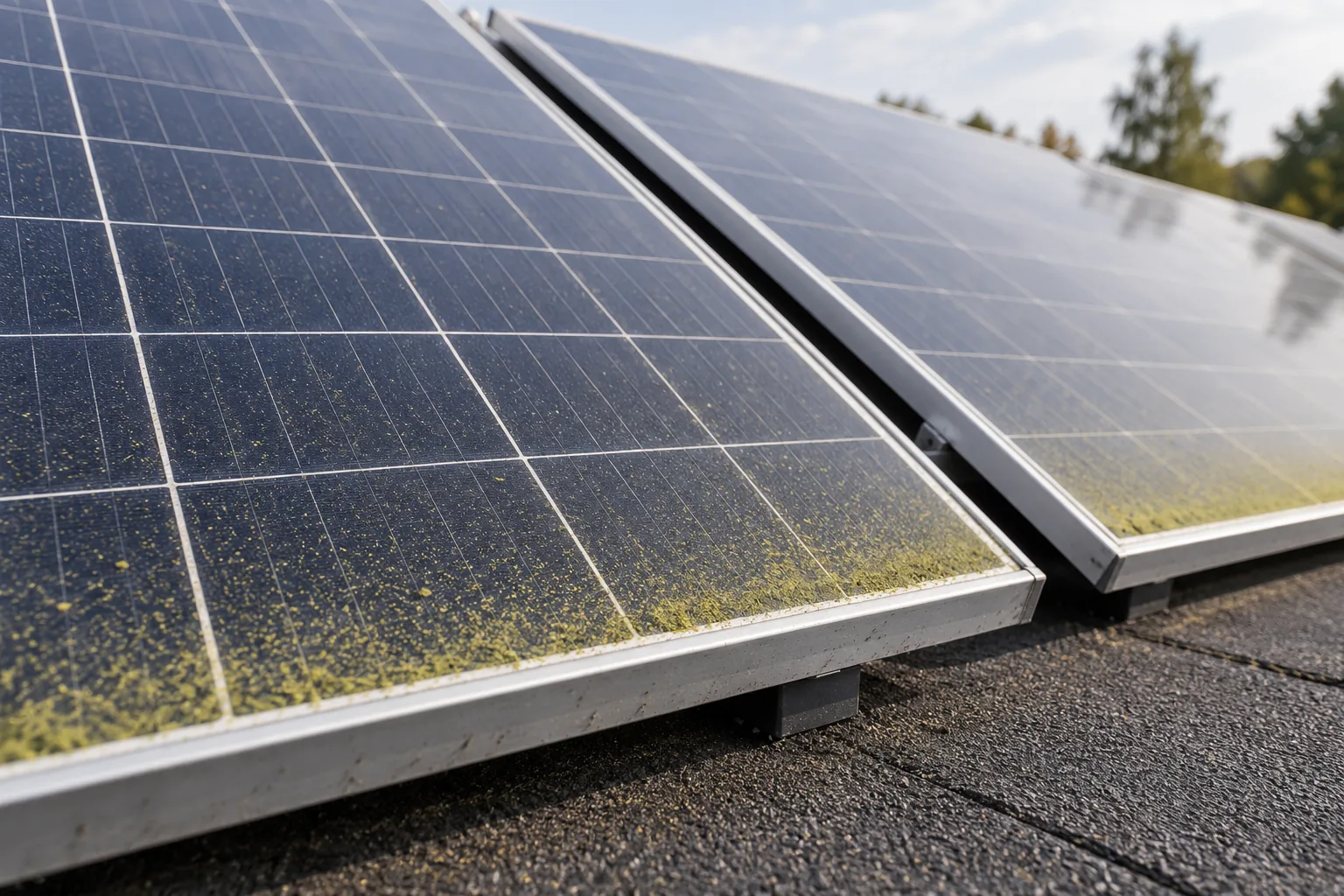
Look for a reason to clean
Stand on the ground and look for visible film, bird deposits, leaves or other material on the panel face. Note nearby trees, construction work or irrigation that may add residue. A roof inspection is not a reason to climb onto a roof yourself. If you have an installer app, compare output with the system’s normal pattern over several similar days, rather than treating one cloudy afternoon as proof of soiling. Ask the installer whether any alert suggests an electrical fault before paying to clean the glass.
What rain can and cannot tell you
Rain may remove loose material, but it is not a reliable test that the panel face is clean. National Renewable Energy Laboratory researchers found persistent pollen soiling at the North Carolina utility-scale arrays they studied even after rainfall. That study is a useful reason to inspect the actual surface; its measured losses do not predict what a San Antonio rooftop will gain from cleaning. Roof pitch, local dust, tree cover, panel angle and time since the last service all differ.
Put safety and the panel warranty first
- Read the module and installer cleaning instructions. Ask a cleaner how the method follows them; coatings and warranties can differ.
- Describe the array’s roof height and access in the quote request. If safe access is uncertain, let a qualified contractor decide whether the job is feasible.
- Ask how nearby electrical equipment, wiring and roof materials will be protected. A glass-cleaning crew should not diagnose an electrical production problem.
- Confirm whether the price covers only the panel face or also removal of leaves around the array. Never assume gutter work or repairs are included.
Texas Window Washing’s current solar page says its crew uses purified water and soft brushes on water-fed poles, does not pressure wash panels, and quotes each job after evaluating the setup. Those are company-described practices, not a universal method for every module. A homeowner should ask the same method and access questions of any provider.
How to judge the result
Before-and-after photos can show that visible residue was removed. They cannot, alone, establish an energy gain. Output moves with sunlight, temperature, shade and time of year. A useful follow-up is to review the monitoring app over comparable conditions and contact the installer if production still looks unusual. The Department of Energy treats cleaning as one part of broader photovoltaic operations and maintenance, alongside checks for faults and damage.
Sort the observation into the right next step
Visible residue gives you a surface question: what is on the panel face, and can it be removed using the module’s care instructions? An app alert gives you an equipment question for the installer. A lower reading without an alert or visible dirt gives you a comparison question: are you comparing similar sunlight, shade and seasonal conditions? Those categories can overlap, but they should not be collapsed into “the panels need washing.” A ground-level photograph and the installer’s interpretation of a warning may settle more than a cleaning date would.
A realistic maintenance rhythm
A one-time cleaning may be enough when the problem was a nearby project or an isolated bird deposit. A property beneath trees may need a different cadence. Record the date, surface condition and photographs after a clean; revisit the panels only when new evidence appears. That small log is more useful than an automatic twice-a-year promise because it connects the next decision to your actual array. If the monitoring app suggests persistent underperformance on comparable clear days, ask the installer to assess the system before assuming the glass is the cause.
A useful contrast: deposits versus a cloudy week
Consider two illustrative situations. A homeowner can see bird deposits across a row of modules but has no system alert. Another sees clear-looking panels and notices lower output during a week with different weather. The first has a concrete reason to discuss surface cleaning, subject to the manufacturer instructions and safe access. The second has not yet isolated a cleaning problem. Reviewing the monitoring period or asking the installer for help is the more useful first decision. Neither situation establishes a percentage gain from washing, and a clear surface cannot rule out an equipment issue.
What to revisit after a clean
Use a cleaner surface as a new observation point, not proof that every future change is dirt. If the same visible deposit returns, look for the local source and discuss whether another visit would be useful. If the glass remains clear while an alert or unexplained production concern persists, return to the installer. Keep photographs aimed at the same part of the array so you can distinguish a genuinely new layer of material from a change in glare or viewing angle. There is no need to climb onto the roof to make that comparison.
Sources and further reading
Decided that the surface needs attention?
Review what a panel-cleaning visit can cover and which array details affect the plan.
Explore solar panel cleaning